
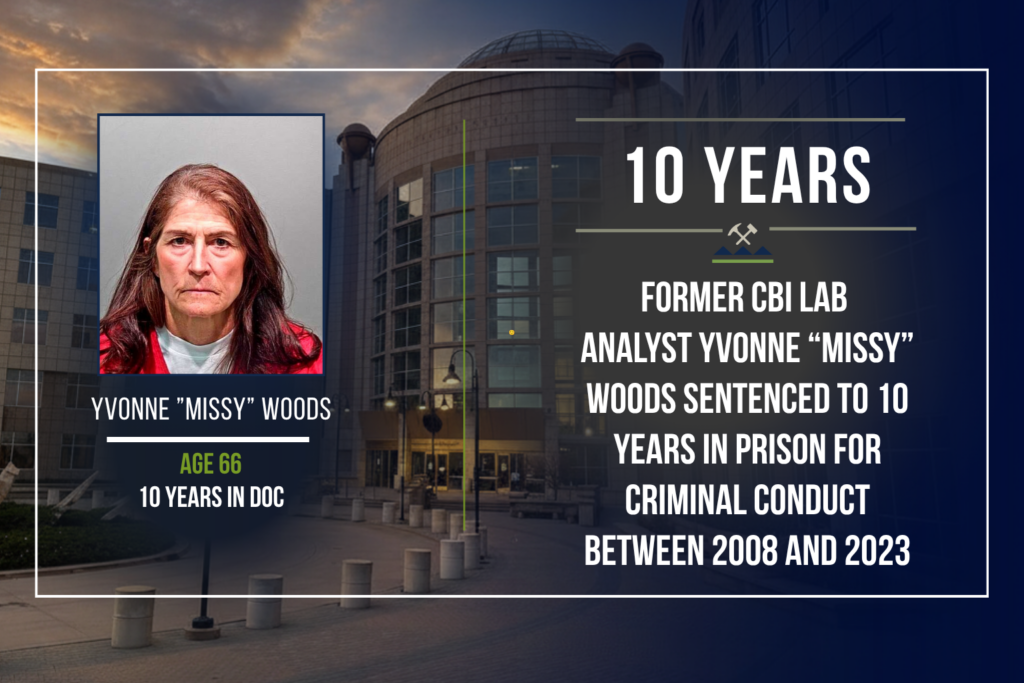
GOLDEN, Colo. (Sept. 8, 2026): Today, District Court Judge Andrew Poland sentenced former Colorado Bureau of Investigation forensic scientist Yvonne “Missy” Woods, 66, to ten years in the Colorado Department of Corrections for criminal conduct committed between 2008 and 2023.
Woods pleaded guilty on June 23 to the following four felony charges:
Count 1: Cybercrime, a class 2 felony
SENTENCE: 10 years
Count 2: Perjury in the First Degree, a class 4 felony
SENTENCE: 6 years concurrent
Count 103: Attempt to Influence a Public Servant, a class 4 felony
SENTENCE: 6 years concurrent
Count 104: Forgery, a class 5 felony
SENTENCE: 3 years concurrent
The plea consolidated the original charges and required Woods to accept responsibility for the full scope of her criminal conduct. Under the agreement, she faced a mandatory prison sentence ranging from eight to sixteen years.
The Court has set a restitution hearing on Thursday, November 12, 2026, at 8:00 AM.
Sentencing Details
At Tuesday’s hearing, Chief Deputy District Attorney Darren Kafka described Woods’ actions as “appalling,” telling the Court, “As a criminal justice professional and a former scientist myself, I find them impossible to comprehend.”
Kafka continued, “The first step in regaining trust is to thoroughly and unequivocally condemn these actions. Even if the motivation was laziness, arrogance, or an urge to abuse power, what comfort does that offer to those denied justice? There was no justification for this behavior. It is barely comprehensible. Yet its impact—on victims who were never believed, defendants who must question whether they were treated fairly, and the forensic, law enforcement, defense, and court personnel who must pick up the pieces—is extensive.”
Woods also addressed the full courtroom before the sentence was imposed.
“My actions affected not only the integrity of the criminal justice system, but also the people whose lives were touched by the cases in which I worked,” Woods said. “I take responsibility for the conduct and for the offenses to which I pleaded guilty, and I know that an apology cannot undo the harm. For many years, I was entrusted with evidence that could have profound consequences for defendants, victims, families and the courts. I failed that responsibility. I am deeply sorry for that failure and for the consequences that followed.”
In imposing the sentence, Judge Andrew Poland described the case as “intentional misconduct by a highly trained professional occupying a position of extraordinary trust.”
“Her responsibility was straightforward: perform the scientific work accurately and honestly, follow the procedures governing that work, report the results, and allow others in the criminal justice system to determine their significance,” Judge Poland said. “She failed to do that.”
“Today’s sentencing brings the criminal prosecution of Missy Woods to a close, but it is only the beginning of the work required to repair the damage she caused throughout Colorado,” District Attorney Alexis King said. “Her conduct undermined trust in our justice system and compromised the confidence that law enforcement, defendants and their attorneys, victims, and the public must be able to place in forensic evidence.”
Investigative Overview
The investigation began in September 2023, when a Colorado Bureau of Investigation (CBI) intern discovered missing DNA data in a sample Woods processed in 2018. A broader review revealed similar alterations and deletions, prompting CBI to request an independent criminal investigation by the South Dakota Division of Criminal Investigation (SDDCI). This investigation evaluated cases that were initially identified by CBI and then verified through mathematical analysis by SDDCI.
Based on that evidence, our Office filed 102 criminal counts against Woods, addressing conduct between 2008 and 2023 that we determined constituted crimes under Colorado law and that could be proven beyond a reasonable doubt.
The prosecution focused on instances in which Woods’ manipulation of DNA data resulted in false or misleading laboratory reports and required a new lab report to be issued.
Impact on Victims
Investigators identified 52 lab reports containing statements by Woods that were untrue. In a 53rd case, Woods made statements that were technically accurate but appeared calculated to discourage a detective from acting on the results.
In most of the charged criminal conduct, Woods reported that DNA was not present when DNA had, in fact, been detected. Her actions stopped many of the affected cases during the earliest stages of investigation and DNA testing, before the evidence could reach the point of identification or comparison.
In January 2025, our Office notified each law enforcement agency that had received a false report identified through the criminal investigation and provided information specific to its case. Because those agencies were responsible for the underlying investigations, they were asked to evaluate the new information and determine the appropriate follow-up, including contact with affected parties or victims.
The 53 cases involving false or misleading lab reports do not represent the full number of cases affected by Woods’ alterations of laboratory data. Her manipulation of values within lab notes affected hundreds of additional cases, however, did not result in a false report. Digitally based criminal conduct committed after 2008 was incorporated into the cybercrime charge even when it did not result in a separate false report or support an additional charge of forgery or attempt to influence a public servant.
“All of this created a mire of uncertainty and confusion that CBI and the State of Colorado as a whole will struggle to untangle for, I suspect, long after Ms. Woods’ sentence is discharged,” said Kafka. “This monumental effort, still underway, has cost the State many millions of dollars, an effect Ms. Woods acknowledged responsibility for by her plea of guilty to Count 1, cybercrime.”
The criminal investigation did not uncover evidence establishing that Woods produced false DNA identifications, false comparisons or false positive results.
Of the cases underlying the charged criminal conduct, 41 did not result in criminal charges against a suspect. Thirty two involved women and children who reported sexual assault.
In those cases, Woods deleted values indicating that male DNA was present and then issued reports stating that no male DNA had been found. Her conduct eliminated opportunities for additional testing, comparison and investigation.
“These women and children, and the detectives entrusted with their stories, believed their evidence would be handled honestly and carefully,” King said. “They trusted that the process would operate with rigor, integrity and respect for the person behind each sample. Instead, Ms. Woods substituted her own judgment for the evidence and for the investigative process.”
Twelve false lab reports were connected to cases in which criminal charges were filed against a suspect. Three of those cases proceeded to trial. One resulted in a conviction, and two resulted in acquittals. Woods pleaded guilty to perjury based on false testimony she provided during the trial that resulted in a conviction for first degree murder.
Of the remaining nine cases, six resulted in plea agreements, two were dismissed and one remains in warrant status.
Each of the 102 charges originally filed against Woods permitted probation under Colorado law.
The plea agreement eliminated probation as a possible sentence and guaranteed a term of imprisonment.
“This resolution required Ms. Woods to accept criminal responsibility and to accept a meaningful prison sentence,” King said. “No outcome can restore the confidence she took from our justice system, make the victims affected by her conduct whole or answer every question Colorado will face in the years ahead. What this resolution provides is accountability for the criminal conduct we could prove beyond a reasonable doubt.”
Woods worked for CBI from January 1994 until November 2023, including at two laboratory locations in Jefferson County.
The investigation and prosecution required nearly two years of work by the First Judicial District Attorney’s Office and the South Dakota Division of Criminal Investigation.
“We are deeply grateful to the investigators, prosecutors and professionals who devoted themselves to this highly complex and unusual case,” King said. “We are also grateful to the South Dakota Division of Criminal Investigation for the independence, expertise, professionalism and partnership it brought to this work.”
Next Steps
The conclusion of the criminal prosecution does not conclude the review of affected cases, related litigation or the need for institutional accountability.
District Attorney King serves on the CBI Forensic Services Committee, which was formed in response to the misconduct in this case, to promote stronger scientific integrity, operational quality, transparency and accountability within CBI Forensic Services.
“Trust in forensic science requires integrity at every step, including the preservation of evidence, complete documentation, meaningful oversight and accountability,” King said. “For Colorado, today is not simply the end of a prosecution. It is the beginning of a long journey to address the damage caused by Ms. Woods and rebuild public trust.”
Each affected case must be evaluated individually based on the evidence, its procedural history and any legal claims presented.
Post-sentencing press comments: https://youtu.be/xze-GquC4dw